

How Is Restless Leg Syndrome Diagnosed in Port St. Lucie, FL?
Restless Leg Syndrome (RLS) is a disruptive neurological condition characterized by an overwhelming, uncomfortable urge to move your legs, which typically worsens during periods of rest or at night. Because there is no single lab test or imaging scan for RLS, the condition is diagnosed through a comprehensive clinical evaluation of your medical history, sleep patterns, and specific symptom criteria to rule out other underlying causes. To uncover the root cause of your nighttime discomfort and receive a highly personalized treatment plan, visit Dr. David Husted for an expert evaluation today. For more information, contact us today or book an appointment online. We are conveniently located at 266 NW Peacock Blvd Suite 203 Port St. Lucie, FL 34986.
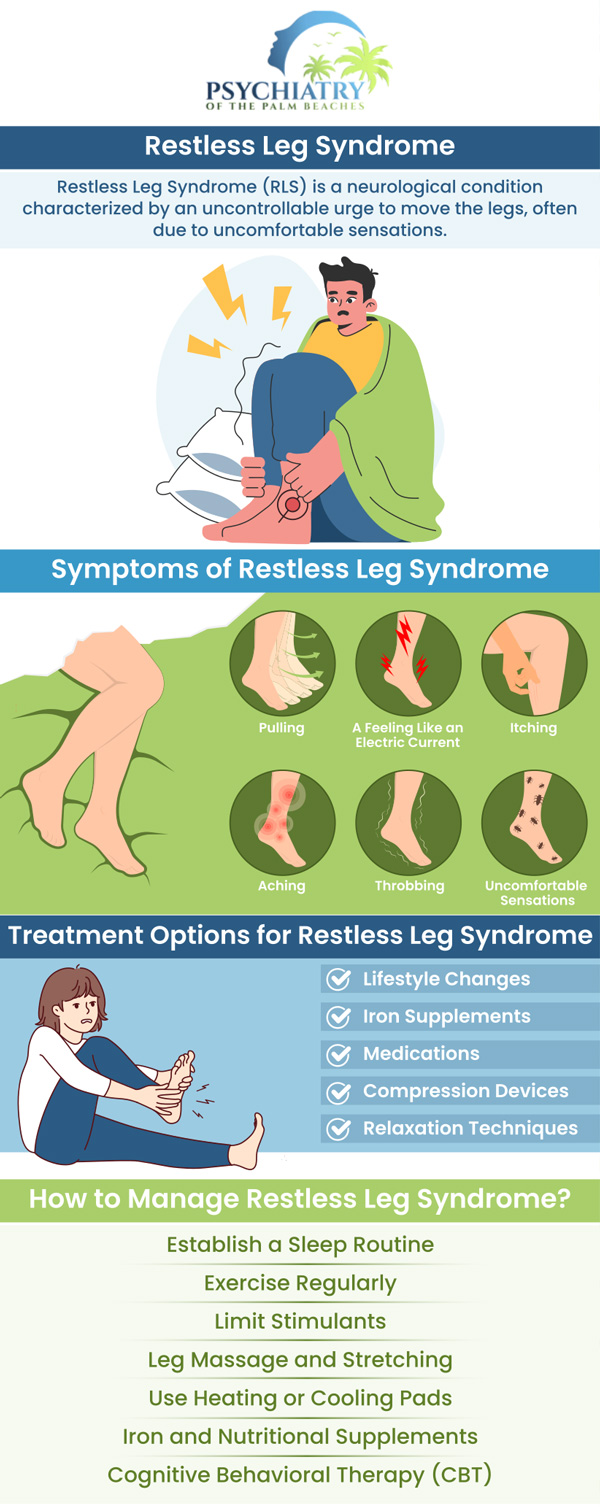
Table of Contents:
How is Restless Leg Syndrome diagnosed?
What should I expect during a doctor’s appointment for RLS diagnosis?
Can RLS be diagnosed in children?
Are there any specific criteria for diagnosing RLS?
What to Expect During a Restless Leg Syndrome Diagnosis at Psychiatry of the Palm Beaches
Restless Leg Syndrome (RLS), also known as Willis-Ekbom disease. Because RLS is a clinical diagnosis—meaning there is no single test to confirm it—our approach begins with a comprehensive evaluation in our welcoming office environment.
Thorough Clinical Evaluation
Our providers start with a detailed medical and psychiatric history, focusing on the characteristic symptoms of RLS: an uncontrollable urge to move the legs, often accompanied by uncomfortable sensations that are worse during periods of rest and improve with movement. We pay careful attention to the timing and pattern of your symptoms, especially if they worsen in the evening or at night—a hallmark of RLS.
Application of Diagnostic Criteria
Our psychiatric specialists use established diagnostic criteria to confirm RLS, including:
● An urge to move the legs, usually with unpleasant sensations
● Symptoms that begin or worsen during periods of rest or inactivity
● Relief of symptoms with movement
● Symptoms that are more severe in the evening or at night
We will also discuss sleep disturbances, daytime fatigue, and how these symptoms impact your mood, functioning, and overall quality of life.
Comprehensive Assessment
To ensure an accurate diagnosis, our team conducts a physical and neurological examination to rule out other possible causes, such as peripheral neuropathy or other movement disorders. We may recommend blood tests to check for underlying issues—such as iron deficiency, kidney problems, or vitamin deficiencies—that can contribute to RLS. Since RLS can sometimes run in families, we may also ask about your family history.
When Further Testing is Needed
If your symptoms are particularly severe, atypical, or suggest another sleep disorder, our providers may refer you for a sleep study (polysomnography). While not always necessary, this test can help identify periodic limb movements during sleep or rule out other sleep disorders that may mimic RLS.
During your RLS evaluation at our practice, you can expect a compassionate, comprehensive approach.
Our psychiatric specialists will begin by having an in-depth conversation with you about your symptoms, medical history, and lifestyle. You’ll be asked to describe the sensations you experience in your legs—when they occur, how long they last, and what seems to help or worsen them. We pay particular attention to patterns, such as whether your symptoms are more pronounced at night or at rest, and how movement affects them.
Because RLS can sometimes be linked to underlying neurological or psychiatric conditions, our clinicians will also perform a physical and neurological assessment. We’ll review your family history and the medications you’re currently taking, as both factors can influence RLS symptoms. If you are dealing with co-occurring concerns such as anxiety, depression, or insomnia—which we frequently address at Psychiatry of the Palm Beaches—please let us know, as these can affect your treatment plan.
Sleep is a major focus at our practice, and we know RLS often disrupts restful sleep. We’ll ask about your sleep patterns, daytime fatigue, and how RLS is affecting your mental health and daily life. In some cases, we may recommend blood tests to look for contributing factors like iron deficiency or kidney issues.
If needed, we might ask you to keep a sleep diary or refer you for a sleep study to gain more insight into your symptoms. At the conclusion of your visit, we’ll work together to develop a personalized plan, which may include lifestyle adjustments, further evaluation, or medication tailored to your needs.
RLS in children presents with symptoms similar to those seen in adults—an uncontrollable urge to move the legs, often accompanied by uncomfortable sensations. Young patients may not be able to fully describe the sensations they are experiencing. Instead, they may say their “legs feel funny” or “I have to move my legs,” which can easily be mistaken for growing pains or even behavioral issues. At Psychiatry of the Palm Beaches, our experienced clinicians are skilled at recognizing the subtle ways RLS may present in children.
Comprehensive Evaluation and Diagnosis
Our team uses specific criteria to diagnose RLS, including:
● A clear urge to move the legs, often with unpleasant sensations.
● Relief of symptoms with movement.
● Symptoms that are worse at rest or in the evening.
● Exclusion of other possible causes, such as muscle cramps, arthritis, or ADHD, which can sometimes present with similar features.
A family history of RLS or periodic limb movements during sleep may further support the diagnosis. We may also recommend blood tests to assess for iron deficiency, which is often associated with RLS.
Restless Legs Syndrome (RLS), also known as Willis-Ekbom Disease, can significantly impact your quality of life—especially when it disrupts your ability to relax or get restorative sleep. Our experienced psychiatric team recognizes that RLS is diagnosed primarily through a careful review of your symptoms and medical history, as there are currently no definitive laboratory tests or imaging studies for this condition.
As part of our comprehensive psychiatric evaluation, we pay close attention to how your symptoms may improve temporarily with movement, and whether they tend to worsen in the evening or at night. These patterns help us distinguish RLS from other conditions such as leg cramps, arthritis, or anxiety-related restlessness.
At Psychiatry of the Palm Beaches, we also consider factors that frequently overlap with psychiatric care, such as sleep disturbances, daytime fatigue, and mood changes. Because RLS can affect sleep and mental well-being, our clinicians are thorough in evaluating whether your symptoms may be linked to other behavioral or medical conditions. We may ask about your family history, as RLS can sometimes run in families, and, if appropriate, order blood tests to check for iron deficiency or other underlying contributors.
Our holistic approach ensures that we not only consider the physical aspects of RLS but also its impact on your mental health and daily functioning.
At Psychiatry of the Palm Beaches, Dr. David Husted takes a careful and personalized approach when evaluating Restless Leg Syndrome (RLS). If you come in with symptoms like uncomfortable leg sensations, an urge to move, or sleep disruption, he will begin by listening closely to your experience. You’ll talk through when symptoms occur, what they feel like, and how they affect your evenings, rest, and daily functioning.
Dr. Husted will review your medical and psychiatric history, including medications, family history, and sleep patterns. Because RLS can be influenced by iron levels, underlying health conditions, or certain prescriptions, he looks at the full picture rather than focusing on symptoms alone.
When appropriate, a physical or neurological screening may be recommended to rule out other conditions such as neuropathy or circulation issues. Bloodwork may also be ordered to check for iron deficiency or other contributing factors.
If RLS is diagnosed, Dr. Husted will explain everything clearly and outline a tailored treatment plan. This may include lifestyle adjustments, sleep strategies, addressing medical contributors, and medication if needed. His goal is simple: reduce your symptoms, improve your sleep, and help you feel more comfortable day to day. For more information, contact us today or book an appointment online. We are conveniently located at 266 NW Peacock Blvd Suite 203 Port St. Lucie, FL 34986. We serve patients from Port St. Lucie FL, Beau Rivage West FL, River Park FL, Fort Pierce FL, Lakewood Park FL, and surrounding areas.
Check Out Our 5 Star Reviews



Additional Services You May Need
▸ Mental Wellness
▸ Relationship Coaching
▸ Depression and Mood Disorders
▸ Women’s Health
▸ Panic Disorder
▸ Medications Management
▸ Men’s Health
▸ Individual Psychotherapy
▸ Bipolar
▸ ADHD
▸ Geriatric Mental Health
▸ Couple’s Counseling
▸ Obsessive Compulsive Disorder
▸ Social Phobia Treatment
▸ Eating Disorders
▸ Post Traumatic Stress Disorder
▸ Psychotic Disorders



 Send Text
 How May I Help You?