

FAQs for Antisocial Personality Disorder
Antisocial Personality Disorder (ASPD) affects how individuals think, feel, and interact with others, which can raise many questions. Our FAQs provide clear, practical answers about symptoms, diagnosis, treatment approaches, and coping strategies. At Psychiatry of the Palm Beaches, our experienced professionals offer evidence-based guidance and personalized support to help individuals and families understand ASPD, navigate challenges, and work toward healthier behaviors and more stable relationships. For more information, contact us today or book an appointment online! We are conveniently located at 2950 Halcyon Lane Suite 605 Jacksonville, FL 32223.
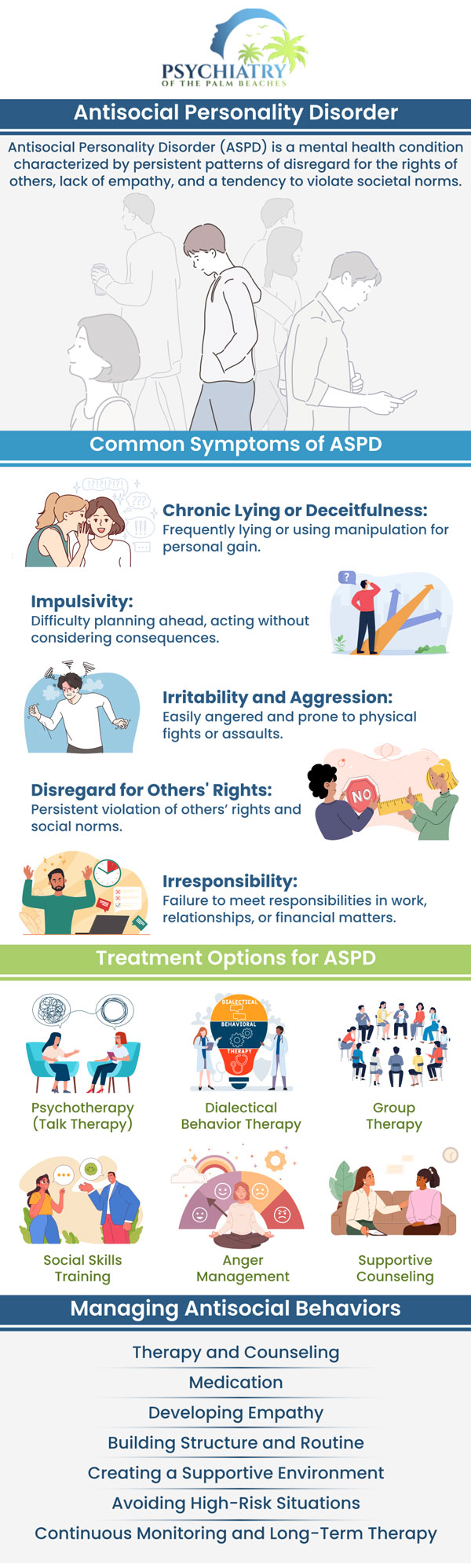
Table of Contents:
What are the symptoms of Antisocial Personality Disorder?
How is Antisocial Personality Disorder diagnosed?
What causes Antisocial Personality Disorder?
Is Antisocial Personality Disorder treatable?
Can people with ASPD change their behavior?
How does Antisocial Personality Disorder affect relationships?
Is Antisocial Personality Disorder more common in men?
What are the risk factors for developing Antisocial Personality Disorder?
How does Antisocial Personality Disorder impact work and social life?
Can Antisocial Personality Disorder lead to criminal behavior?
What types of therapy are used to treat ASPD?
What treatment support is available for Antisocial Personality Disorder at Psychiatry of the Palm Beaches?
Individuals with ASPD may consistently disregard social norms and laws, sometimes resulting in repeated illegal activities or deceitful behaviors for personal gain or pleasure. Other common symptoms include:
● Impulsivity: Difficulty planning ahead or considering the consequences of actions.
● Irritability and Aggressiveness: Frequent involvement in physical fights or assaults.
● Reckless Behavior: Disregard for personal safety or the safety of others, often engaging in risky activities.
● Lack of Remorse: Indifference or rationalization after harming or mistreating others.
● Irresponsibility: Difficulty maintaining employment or meeting financial and social obligations.
Diagnosis begins with a thorough clinical evaluation, during which our clinicians gather detailed information about an individual’s behavior patterns, emotional responses, interpersonal relationships, and personal history—particularly focusing on conduct since childhood or adolescence.
Our psychiatrists utilize the gold-standard criteria outlined in the Diagnostic and Statistical Manual of Mental Disorders (DSM-5). This means we look for a long-standing pattern of disregard for the rights of others, impulsivity, deceitfulness, irritability, aggression, and lack of remorse. To ensure a complete and accurate diagnosis, we may also consult with family members (with consent), review medical and legal histories, and rule out other possible mental health conditions or medical causes.
Importantly, ASPD can only be diagnosed in individuals age 18 or older, with documented evidence of conduct disorder symptoms before age 15. At Psychiatry of the Palm Beaches, we take great care to distinguish ASPD from other disorders such as schizophrenia or bipolar disorder, ensuring each diagnosis is precise and well-informed.
Antisocial Personality Disorder (ASPD) is influenced by a combination of genetic, environmental, and social factors. Genetics play a role, especially in individuals with a family history of personality disorders, and brain function differences affecting impulse control and emotional regulation are often observed.
Environmental factors, particularly during childhood—such as neglect, abuse, or inconsistent parenting—can increase the risk of developing antisocial behaviors. Children with conduct disorder are at higher risk of developing ASPD as adults.
Socioeconomic conditions, exposure to crime, substance use, or association with peers exhibiting antisocial behaviors can further contribute. ASPD results from the complex interaction of inherited traits, early experiences, and environmental stressors. Our clinicians provide thorough assessment and evidence-based treatment tailored to each individual’s unique needs.
Antisocial Personality Disorder (ASPD) is a particularly complex and challenging mental health condition. ASPD is marked by a longstanding pattern of disregarding the rights of others, impulsivity, deceitfulness, and a lack of remorse. While treatment can be difficult, our experienced team is committed to providing compassionate, evidence-based care to individuals living with ASPD.
Currently, there are no medications specifically approved for the treatment of ASPD. However, our psychiatrists can prescribe medications to help manage symptoms such as irritability, aggression, or co-occurring conditions like depression or anxiety, ensuring a comprehensive approach to care. The foundation of treatment at Psychiatry of the Palm Beaches is psychotherapy, with a special emphasis on cognitive behavioral therapy (CBT). Through CBT and other therapeutic modalities, our clinicians work closely with patients to help them recognize and change destructive patterns of thinking and behavior.
We understand that individuals with ASPD may have limited motivation to engage in therapy or may not see themselves as needing help. Our team is skilled in building trust and rapport, taking the time to tailor interventions that address each person’s unique needs and challenges. Early identification—especially in adolescence or young adulthood—can lead to better outcomes. With support from our multidisciplinary team, as well as coordination with family members, social services, and structured environments, we strive to help individuals manage their symptoms and improve their quality of life.
Antisocial Personality Disorder (ASPD) involves a persistent disregard for others’ rights, impulsivity, and difficulty following social norms. While core traits can be deeply ingrained, behavioral improvement is possible with the right support and motivation. Life changes, legal consequences, or relationship challenges can increase the likelihood of positive response to treatment.
At Psychiatry of the Palm Beaches, we use evidence-based approaches such as cognitive behavioral therapy (CBT), social skills training, and medication management for co-occurring conditions. These interventions help clients manage symptoms, make healthier decisions, and improve relationships. Each treatment plan is personalized, recognizing that progress is gradual and requires long-term commitment.
Early intervention, especially during adolescence or young adulthood, is crucial for maximizing change. While a complete personality transformation is rare, many individuals can learn to manage impulses, reduce harmful behaviors, and enhance social functioning with ongoing therapy.
Family involvement, structured environments, and consistent engagement are also key. We guide families in setting realistic expectations and provide support strategies to help loved ones navigate setbacks and celebrate progress, promoting sustained behavioral improvement.
Antisocial Personality Disorder (ASPD) can significantly impact personal, family, and social relationships. Individuals with ASPD often show a persistent disregard for others’ rights and feelings, which can erode trust and emotional safety. Chronic lying, manipulation, and diminished empathy may leave loved ones feeling insecure, devalued, or betrayed.
These behaviors can create ongoing conflict, emotional distress, and instability in romantic and family relationships. Impulsivity, risky behaviors, and commitment challenges may further strain relationships and contribute to legal or financial difficulties.
At Psychiatry of the Palm Beaches, our team provides assessment, diagnosis, and individualized therapy for those with ASPD and guidance for their families. We focus on education, coping strategies, and establishing healthy boundaries to help improve relationship dynamics and support more positive interactions.
Antisocial Personality Disorder (ASPD), a mental health condition marked by a pervasive disregard for the rights of others, impulsivity, and sometimes manipulative or criminal behavior. Our clinical experience aligns with national research showing that ASPD is diagnosed more frequently in men than in women, with prevalence estimates in the general population ranging from 1% to 4%. In forensic and correctional settings, the gender gap is even more pronounced, with males making up the majority of ASPD cases.
Understanding the reasons behind these gender differences is crucial for providing effective, personalized care. Biological factors like genetics, brain structure, and hormonal influences such as testosterone may contribute to this disparity. Additionally, cultural expectations and gender roles can affect how antisocial behaviors present and are recognized, sometimes leading to underdiagnosis in women or overdiagnosis in men.
We also recognize that women with ASPD may exhibit different symptoms, which can sometimes result in their condition being overlooked. Our team is dedicated to staying informed about the latest research and adapting our clinical approach to ensure all patients receive thorough and sensitive evaluation and care.
Antisocial Personality Disorder (ASPD) is a complex mental health condition shaped by a combination of genetic, environmental, and psychological factors. At Psychiatry of the Palm Beaches, our team recognizes the importance of identifying and addressing the unique risk factors that may contribute to ASPD.
A family history of ASPD or other personality disorders can indicate a genetic predisposition, increasing the likelihood of developing this condition. The environment in which a child grows up is equally important—children exposed to abuse, neglect, or unstable family situations are at a higher risk for ASPD later in life. Early behavioral issues, such as conduct disorder before the age of 15, are strong predictors, making early intervention crucial.
Additional risk factors include exposure to violence, inconsistent discipline, and lack of parental involvement—challenges that some families in the Palm Beaches area may face. Socioeconomic stressors, such as living in impoverished or high-crime neighborhoods, can also elevate the risk. Statistically, males are more likely to be diagnosed with ASPD than females, and co-occurring conditions like substance abuse or ADHD can further increase susceptibility.
We emphasize a comprehensive approach to mental health care, focusing on early identification, prevention, and personalized treatment. Our experienced psychiatrists offer thorough assessments and evidence-based therapies, supporting individuals and families dealing with the challenges of ASPD and related conditions.
In the workplace, individuals with ASPD may struggle to respect the rights and boundaries of colleagues, leading to frequent conflicts with coworkers, supervisors, or authority figures. Impulsivity, rule-breaking, and a disregard for workplace norms can undermine job performance and result in disciplinary action or job loss. These behaviors often interfere with building trust and maintaining effective teamwork, making it difficult to achieve stable, long-term employment.
Socially, ASPD often impairs the ability to form and maintain healthy relationships. Difficulties with empathy, manipulation, and exploiting others for personal gain can erode trust and drive people away. This frequently leads to social isolation, as friends and loved ones may feel unsafe or betrayed. Over time, these patterns can reinforce antisocial behaviors and make positive social engagement even more challenging
.
At Psychiatry of the Palm Beaches, our experienced clinicians offer comprehensive assessment, diagnosis, and treatment planning for those struggling with Antisocial Personality Disorder. Through a combination of psychotherapy, medication management, and support for families and loved ones, we work collaboratively to address the unique challenges ASPD presents.
Individuals with ASPD may often display impulsive behaviors, deceitfulness, and a pattern of struggling to adhere to lawful or ethical standards. These characteristics can sometimes lead to conflicts with the law or difficulties in personal and professional relationships.
Research highlights a significant association between ASPD and an increased risk of criminal activity, especially when the disorder is left untreated or is accompanied by substance use or negative environmental influences. However, not everyone with ASPD engages in criminal behavior. Many individuals with this diagnosis might never encounter legal issues, yet they may face ongoing challenges in social and occupational functioning.
At Psychiatry of the Palm Beaches, our team is committed to a nonjudgmental, individualized approach. We understand that ASPD does not predetermine one’s actions; rather, the risk of harmful behavior can be significantly reduced with early intervention, comprehensive therapy, and strong support systems. Our clinicians work to address the unique needs of each patient by considering personal history, symptom severity, and contributing factors, such as co-occurring disorders and life circumstances.
At Psychiatry of the Palm Beaches, we use a specialized, multifaceted approach to treat Antisocial Personality Disorder (ASPD). Cognitive Behavioral Therapy (CBT) helps patients identify and change negative thinking and behavior patterns, recognize triggers, build problem-solving skills, and develop empathy for healthier interactions.
Schema-focused therapy explores longstanding patterns shaped by early-life experiences, supporting more adaptive behaviors. Group therapy provides a structured environment to practice social skills, receive feedback, and understand the impact of behaviors on others. Motivational interviewing enhances readiness for change, particularly in the early stages, while family therapy improves communication, sets healthy boundaries, and fosters supportive relationships when family dynamics are involved.
Our individualized treatment plans may also include medication management for co-occurring conditions and additional support services. By combining these therapies, we help patients manage symptoms, build healthier relationships, and work toward lasting positive change.
At Psychiatry of the Palm Beaches, treatment support for Antisocial Personality Disorder focuses on helping patients recognize harmful behavior patterns, improve decision-making, and build healthier ways to manage relationships and daily challenges. Care may include therapy-based support, cognitive behavioral strategies, emotional regulation techniques, and guidance for managing impulsive or disruptive behaviors. The clinic personalizes care based on each patient’s symptoms, history, and treatment goals, creating a structured approach that supports long-term stability, better communication, and improved overall functioning. For more information, contact us today or book an appointment online! We are conveniently located at 2950 Halcyon Lane Suite 605 Jacksonville, FL 32223. We serve patients from Jacksonville FL, Riverside FL, Mandarin FL, Julington Creek FL, Fruit Cove FL, Orange Park FL, and surrounding areas.
Check Out Our 5 Star Reviews



Additional Services You May Need
▸ Mental Wellness
▸ Relationship Coaching
▸ Depression and Mood Disorders
▸ Women’s Health
▸ Panic Disorder
▸ Medications Management
▸ Men’s Health
▸ Individual Psychotherapy
▸ Bipolar
▸ ADHD
▸ Geriatric Mental Health
▸ Couple’s Counseling
▸ Obsessive Compulsive Disorder
▸ Social Phobia Treatment
▸ Eating Disorders
▸ Post Traumatic Stress Disorder
▸ Psychotic Disorders



 Send Text
 How May I Help You?