

FAQs for Self-Defeating Personality Disorder
Understanding Self-Defeating Personality Disorder can be challenging for individuals and families. Our comprehensive FAQs address common questions about behaviors, emotional patterns, diagnosis, and treatment approaches. At Psychiatry of the Palm Beaches, our committed team provides compassionate guidance and evidence-based care, empowering patients to recognize self-defeating tendencies, improve relationships, and cultivate long-term emotional resilience. For more information, contact us or schedule an appointment online. We are located at 3107 Stirling Road, Suite 107, Ft. Lauderdale, FL 33312.
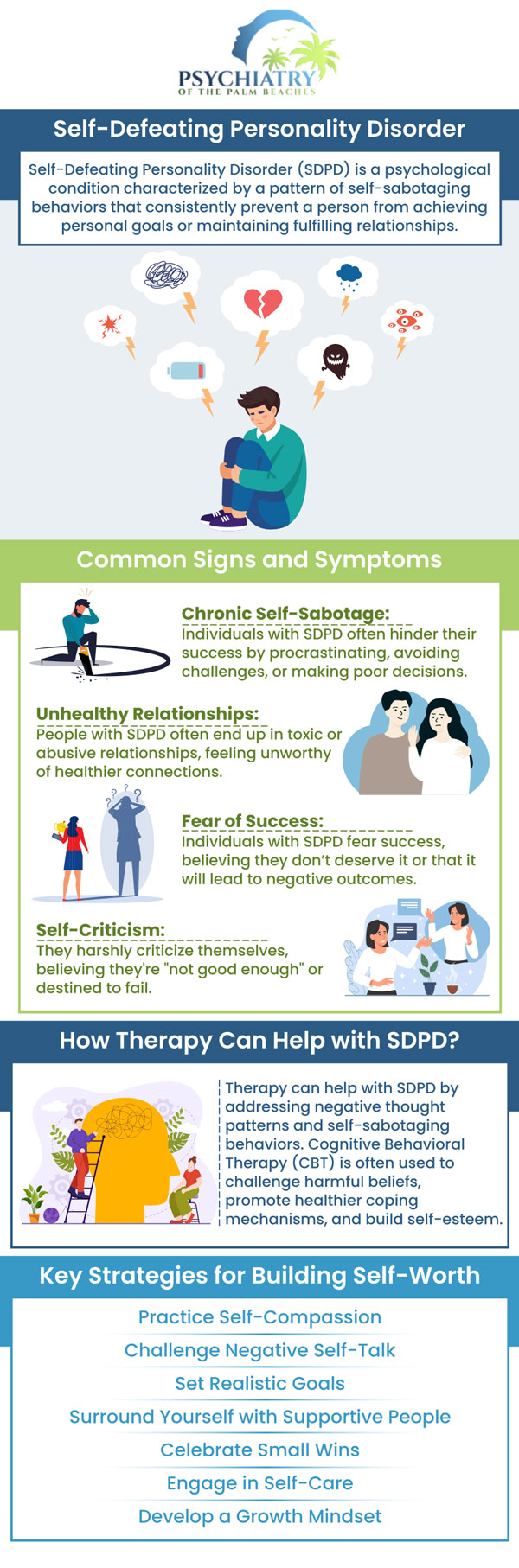
Table of Contents:
What are the symptoms of Self-Defeating Personality Disorder?
How is Self-Defeating Personality Disorder diagnosed?
What causes Self-Defeating Personality Disorder?
How is Self-Defeating Personality Disorder treated?
Can Self-Defeating Personality Disorder be managed?
How does Self-Defeating Personality Disorder affect relationships?
How does Self-Defeating Personality Disorder impact daily life?
Can therapy help treat Self-Defeating Personality Disorder?
How does Self-Defeating Personality Disorder relate to low self-esteem?
Is medication used in treating Self-Defeating Personality Disorder?
What are the long-term effects of Self-Defeating Personality Disorder?
Can Self-Defeating Personality Disorder be mistaken for other personality disorders?
Helping Patients Recognize Self-Defeating Patterns
Self-Defeating Personality Disorder (SDPD), also historically known as masochistic personality disorder, is characterized by a pervasive pattern of self-sabotage and negative behavior. At Psychiatry of the Palm Beaches, we observe symptoms such as individuals consistently gravitating toward people or situations that lead to disappointment, failure, or mistreatment. They may actively reject help from others, fail to accomplish crucial personal goals despite having the proven ability to do so, and strongly resist positive experiences. Additionally, patients often experience an underlying sense of unworthiness, feeling immense guilt or depression following a successful event. Instead of enjoying achievements, they may incite anger in others, ultimately leading to their own suffering. Recognizing these deeply ingrained behavioral symptoms is the vital first step toward seeking compassionate professional care and embarking on a journey of recovery and healthy self-worth.
Diagnosing Self-Defeating Personality Disorder requires a comprehensive and highly detailed evaluation by an experienced psychiatric specialist. At Psychiatry of the Palm Beaches, the diagnostic process begins with a thorough clinical interview to understand the patient’s complete medical and mental health history. Because the symptoms of SDPD often overlap with other complex psychiatric conditions, our providers rely on detailed discussions regarding the patient’s long-term behavioral patterns, relationships, and coping mechanisms. We carefully evaluate whether the individual consistently demonstrates a pervasive cycle of self-sabotage, an inability to enjoy personal success, and a tendency to reject help. By compassionately listening and synthesizing this critical information, the provider can accurately distinguish SDPD from overlapping conditions like severe depression or dependent personality disorder, allowing for the creation of a highly personalized and effective treatment plan.
While the exact root causes of Self-Defeating Personality Disorder are incredibly complex, the expert team at Psychiatry of the Palm Beaches notes that several intersecting factors generally contribute to its development. Early childhood trauma and deeply negative experiences play a profound role. Individuals who grew up enduring significant emotional neglect, chronic abuse, or highly critical environments often develop maladaptive coping mechanisms that rely heavily on self-sabotage. Furthermore, growing up in a home devoid of positive reinforcement can instill deep feelings of unworthiness and hopelessness. Genetics may also contribute to a patient’s underlying psychological vulnerability. Pre-existing personality traits, such as harsh self-criticism, relentless perfectionism, and chronically low self-esteem, significantly increase the risk. Ultimately, SDPD develops as a protective, albeit deeply dysfunctional, method of managing the overwhelming pain and expectations formed during these formative years.
Treating Self-Defeating Personality Disorder involves a deeply compassionate, highly structured, and multifaceted approach. Because individuals with this disorder subconsciously resist help and positive outcomes, specialized psychiatric care is crucial for facilitating meaningful recovery. At Psychiatry of the Palm Beaches, the cornerstone of treatment is long-term, individualized psychotherapy. Cognitive Behavioral Therapy (CBT) and psychodynamic therapy are highly effective in helping patients identify their self-sabotaging patterns, understand their deep-seated feelings of unworthiness, and develop healthier, more constructive coping mechanisms. The therapeutic process is designed to slowly rebuild self-esteem while challenging negative core beliefs. In addition to intensive therapy, careful medication management may be utilized to effectively treat co-occurring symptoms, such as severe depression or debilitating anxiety, thereby creating a more stable emotional foundation for the patient to engage successfully in their long-term therapeutic journey.
Yes, Self-Defeating Personality Disorder can absolutely be managed with consistent, dedicated, and professional psychiatric care. Because the condition involves deeply ingrained patterns of self-sabotage and the subconscious rejection of positive experiences, managing it requires profound patience and highly specialized intervention. At Psychiatry of the Palm Beaches, we help patients actively manage their symptoms by teaching them to recognize their unique emotional triggers before a cycle of self-sabotage begins. Through ongoing individual psychotherapy, patients develop practical, healthy coping strategies to challenge their relentless self-criticism and tolerate the discomfort they feel during moments of success. While managing SDPD is a gradual, long-term process, a highly personalized combination of intensive therapy, a supportive environment, and ongoing psychiatric guidance enables individuals to successfully interrupt these damaging cycles and build a significantly more fulfilling, balanced life.
Self-Defeating Personality Disorder has a profoundly negative and destabilizing impact on interpersonal relationships. Individuals with this condition unconsciously seek out partners or friends who are emotionally unavailable, highly critical, or actively abusive, thereby reinforcing their deep-seated beliefs of unworthiness. At Psychiatry of the Palm Beaches, we frequently observe that even when these individuals encounter caring, supportive partners, they will inadvertently sabotage the relationship by inciting arguments, withdrawing emotionally, or pushing the person away. This behavior stems from a fundamental inability to accept love or positive treatment without intense guilt or suspicion. Consequently, their relationships are typically characterized by extreme turmoil, chaos, and a complete lack of mutual fulfillment. This persistent pattern of relational destruction eventually leads to severe social isolation, deeply worsening the individual’s underlying depression and reinforcing their maladaptive behavioral cycles.
The impact of Self-Defeating Personality Disorder on daily life is severe and deeply pervasive. Because the disorder compels individuals to actively undermine their own well-being, their daily routines are frequently chaotic and unfulfilling. At Psychiatry of the Palm Beaches, we see patients who constantly sabotage their professional careers by intentionally missing deadlines, failing to complete crucial tasks despite having the necessary skills, or alienating supportive colleagues. Even in their personal time, individuals with SDPD struggle profoundly to enjoy hobbies or simple pleasures, often feeling an intense wave of guilt when experiencing happiness. This relentless cycle of self-imposed failure and chronic dissatisfaction creates an exhausting daily existence. Without targeted psychiatric intervention, the condition continuously drains the individual’s emotional energy, leading to a life characterized by chronic underachievement, pervasive emotional pain, and intense social isolation.
Therapy is absolutely essential and serves as the primary cornerstone for effectively treating Self-Defeating Personality Disorder. Because individuals with SDPD subconsciously resist positive changes and frequently reject direct help, the specialized, highly empathetic environment provided by a skilled therapist is critical. At Psychiatry of the Palm Beaches, we utilize advanced therapeutic modalities, including Cognitive Behavioral Therapy (CBT) and psychodynamic therapy, to facilitate deep healing. Therapy expertly helps patients untangle their complex history of childhood trauma, safely identify their hidden self-sabotaging triggers, and fundamentally challenge their deeply ingrained feelings of unworthiness. By slowly dismantling these negative core beliefs, the therapist empowers the patient to gradually accept positive experiences, develop significantly healthier coping mechanisms, and build genuine self-esteem, ultimately guiding them toward a much more stable and rewarding life.
Self-Defeating Personality Disorder and chronically low self-esteem are intrinsically and profoundly linked. At Psychiatry of the Palm Beaches, our providers recognize that severe, deeply internalized feelings of unworthiness often form the very foundation of this complex disorder. Individuals with SDPD truly believe on a fundamental level that they do not deserve happiness, success, or love. This cripplingly low self-esteem typically originates from severe childhood emotional neglect or trauma. Because they view themselves so negatively, any positive achievement or healthy relationship directly contradicts their internal reality, causing intense anxiety. To relieve this psychological discomfort, they unconsciously sabotage the positive situation to return to a familiar state of failure and rejection. Therefore, successfully treating SDPD requires an intensive, ongoing therapeutic focus on entirely rebuilding the individual’s shattered self-worth and challenging their harsh inner critic.
While there are no specific medications universally approved to cure Self-Defeating Personality Disorder itself, medication management frequently plays a vital, supportive role in a comprehensive treatment plan. The core treatment for SDPD is intensive psychotherapy, but patients very often suffer from severe, co-occurring mental health conditions that heavily impede their therapeutic progress. At Psychiatry of the Palm Beaches, our specialized psychiatric team may carefully prescribe antidepressants, anti-anxiety medications, or mood stabilizers to help effectively manage debilitating symptoms of severe depression, chronic anxiety, or intense mood swings. By stabilizing these overwhelming neurochemical symptoms, the medication provides the patient with a much clearer, calmer emotional baseline. This biological support makes it significantly easier for the individual to actively and successfully engage in their behavioral therapy and confront their deeply ingrained patterns of self-sabotage.
The long-term effects of untreated Self-Defeating Personality Disorder are severe, devastating, and deeply tragic. If the pervasive cycle of self-sabotage is not addressed through professional psychiatric intervention, individuals face a lifetime characterized by profound emotional pain and chronic underachievement. At Psychiatry of the Palm Beaches, we see the tragic consequences of SDPD manifesting as entirely ruined interpersonal relationships, frequent job losses, and severe social isolation. Because the individual constantly rejects help and positive experiences, they are highly susceptible to developing severe, treatment-resistant depression, debilitating anxiety disorders, and dangerous substance abuse issues as they attempt to self-medicate their psychological pain. Ultimately, the relentless internal drive toward failure deeply erodes the individual’s physical and mental well-being, highlighting the absolutely critical need for comprehensive, early, and sustained therapeutic intervention to alter their life’s trajectory.
Yes, Self-Defeating Personality Disorder can easily be mistaken for several other complex psychiatric conditions due to significantly overlapping behavioral symptoms. At Psychiatry of the Palm Beaches, our experts conduct highly detailed diagnostic evaluations because SDPD often mimics the intense emotional dysregulation found in Borderline Personality Disorder (BPD) or the deep reliance on others seen in Dependent Personality Disorder. Furthermore, the persistent feelings of worthlessness and chronic self-sabotage are very frequently confused with severe, treatment-resistant Major Depressive Disorder. However, unlike pure depression, SDPD involves an active, subconscious drive to incite failure and reject positive experiences. Because an accurate diagnosis is absolutely crucial for developing an effective, tailored treatment plan, it requires the highly nuanced clinical judgment of an experienced psychiatric provider to carefully untangle these intricate symptoms and correctly identify the underlying personality structure.
At Psychiatry of the Palm Beaches, care for Self-Defeating Personality Disorder focuses on helping patients identify recurring thoughts, behaviors, and relationship patterns that may affect emotional well-being and daily functioning. The clinic provides personalized mental health support based on each patient’s history, symptoms, and goals. Treatment may include therapy-based coping strategies, cognitive behavioral techniques, emotional regulation support, boundary-setting guidance, and individualized care planning. Psychiatry of the Palm Beaches helps patients build self-awareness, develop healthier responses, improve confidence, and work toward better emotional balance. For more information, contact us or schedule an appointment online. We are located at 3107 Stirling Road, Suite 107, Ft. Lauderdale, FL 33312.We serve patients from Ft. Lauderdale FL, Hollywood FL, Oakridge FL, Dania Beach FL, Lauderhill FL, and surrounding areas.
Check Out Our 5 Star Reviews



Additional Services You May Need
▸ Mental Wellness
▸ Relationship Coaching
▸ Depression and Mood Disorders
▸ Women’s Health
▸ Panic Disorder
▸ Medications Management
▸ Men’s Health
▸ Individual Psychotherapy
▸ Bipolar
▸ ADHD
▸ Geriatric Mental Health
▸ Couple’s Counseling
▸ Obsessive Compulsive Disorder
▸ Social Phobia Treatment
▸ Eating Disorders
▸ Post Traumatic Stress Disorder
▸ Psychotic Disorders



 Send Text
 How May I Help You?